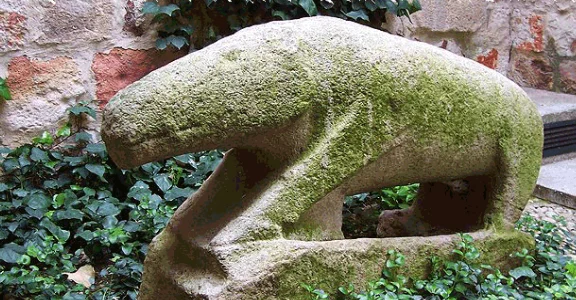
If we had to explain Spanish culture through one food, it would undoubtedly be ham. Today it appears in painting, cinema, literature and our homes, reflecting who we are and who our grandparents were. It is an emblem that now reaches beyond our borders under the name of Spain.
We are not trying to invent an epic story for ham: it already has one. Its development follows the history of the Iberian Peninsula's inhabitants, making every plate of good ham in our homes a piece of living history. Today, then, we explore the origins of ham on the Iberian Peninsula.
Origins: the Phoenicians
There is no ham without pigs. The Phoenicians introduced pigs to the peninsula around 1100 BC, through settlements such as Gadir (Cádiz) and Malaka (Málaga). This trading people achieved remarkable advances in salt preservation. The remains of facilities for salting meat and fish can still be found near Alicante and Larache in Morocco.
Before the Romans
By the time the Romans reached the peninsula, many Iberian and Celtic peoples already knew and ate ham. For these pre-Roman peoples, pigs were objects of veneration and trade, their meat always treated with salt for preservation.

Roman times
After arriving on the peninsula, the Romans adopted local traditions and fell in love with Iberian delicacies. Ham from Pomeipoles (Pamplona) and Tarraco (Tarragona) enjoyed particular prestige. A fossilised ham around 2,000 years old was found in Tarragona.
References to production methods state that ham should be salted for at least 12 days and prepared by expert hands, the ‘vicarius supra cenas’. It was expensive and eaten by wealthy people at banquets: first as ‘gustatio’ to whet the appetite, and again at the end, during the ‘secunda mensa’, to encourage drinking.
Ham exports from the peninsula throughout the empire became so important that Augustus and Agrippa minted Roman coins featuring the shape of a ham tip.

From the Middle Ages onwards
As the Reconquista advanced in the 12th and 13th centuries, new settlers established themselves through pig farming, with semi-wild herds grazing in pastureland and holm-oak woods. Pig slaughter and the subsequent production of cured meats, including ham, became widespread in villages across the country.
There are many references in literature. Gradually, pig rearing and slaughter spread among farming communities, and making hams and cured meats became common in towns and villages throughout Spain. Our grandparents, and many of us, are the living heirs of this tradition.
Lope de Vega, Quevedo and Cervantes are among the writers who praised ham in their books: ‘bare ham bones which, though they would not yield to chewing, did not resist being sucked’. Don Quixote, Cervantes.

Today
Since the 20th century, eating ham and other cured pork products has become widespread. Industrialisation and technological advances have helped us understand the factors involved in curing and maturation, and ham has become a food found in homes everywhere.
A notable development has been the divergence of two types of ham: supermarket ham from lighter, lower-quality pigs, and the more traditional ham found in delicatessens, made from larger pigs and cured more slowly.
We choose pigs with generous fat cover and make ham in the style of Pomeipoles (Pamplona): a good layer of fat, slow curing and just the right amount of salt, achieved by hand-salting in stacks.

Conclusion
Ham is more than food: it is a historical legacy connecting our present to the Phoenicians, the Romans, the Middle Ages and family traditions handed down through generations. At Jamones Villarroya we keep this ancient tradition alive, respecting the craft methods that have made Spanish ham an emblem recognised worldwide.
Comments (0)