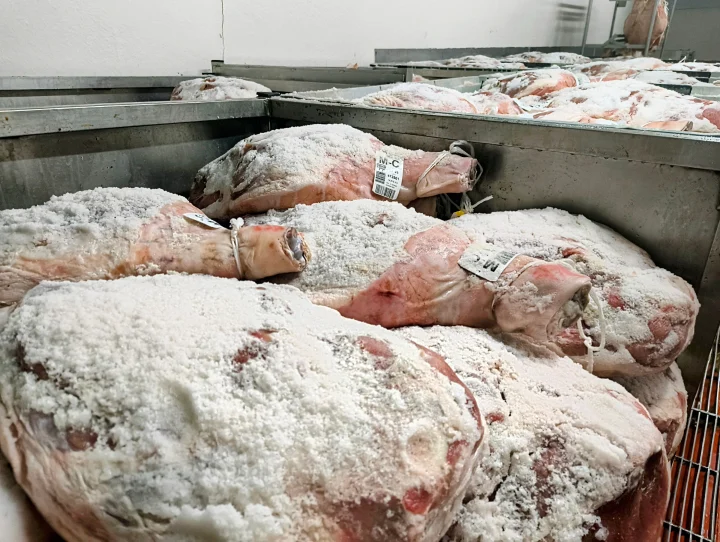
If you enjoy ham, you will know that the right level of salt is a sign of quality. Salting each ham just enough is an art! Today we explain the salting stage and how it determines the final quality. We will also move beyond the familiar rule of ‘one day in salt per kilo of ham’.
What is salt for?
Salt is fundamental to preserving meat. We know that the ancient Egyptians salted meat to store it and keep it edible, and there is evidence of similar practices in China in the third millennium BC. Later, the Romans placed such value on salt that they used it to pay their legionaries—hence the word salarium, or salary.
In Spanish ham, salt serves several purposes: it helps dry the meat and inhibits the growth of pathogens. It also regulates the enzymatic reactions of proteolysis and lipolysis—the very reactions that give ham its delicious flavour.
How to salt a good ham
Whether you are a master ham maker or an enthusiastic reader, we apologise for not revealing our exact formula. We can say that we work traditionally. Pay close attention and you might even work it out!
- Initial sorting
Every producer sorts hams by weight and fat cover. Large hams with plenty of fat are set aside to spend more days in salt.
- Draining residual blood
Next, residual blood is removed from the hams by massage. Although machines can do this, we perform it by hand, drawing on our detailed knowledge of the ham's vascular anatomy.
- Salting methods
From here, there are many possibilities:
- Some companies add salt to a rotating drum, tumbling the hams to achieve fast, intensive salting.
- Other producers use steel containers that allow the salt to drain.
Our choice is clear, as described in J. Bello Gutiérrez's book Jamón Curado: slow salt penetration and long curing improve the quality of our ham. We therefore avoid rapid salting in industrial tumbling drums.
We prefer salt to spread slowly and in just the right amount. Each ham is rubbed individually according to its size and fat cover, then placed in salt stacks of six to eight hams.

Comments (0)