In our previous article we explained how ham is salted. Today we continue with the second stage of production: post-salting, also known as resting.
Once the ham has spent enough days in salt at low temperatures and high humidity, it is washed with lukewarm water. We do this by hand, making sure the surface salt is properly removed, although industrial machines can also perform this task.
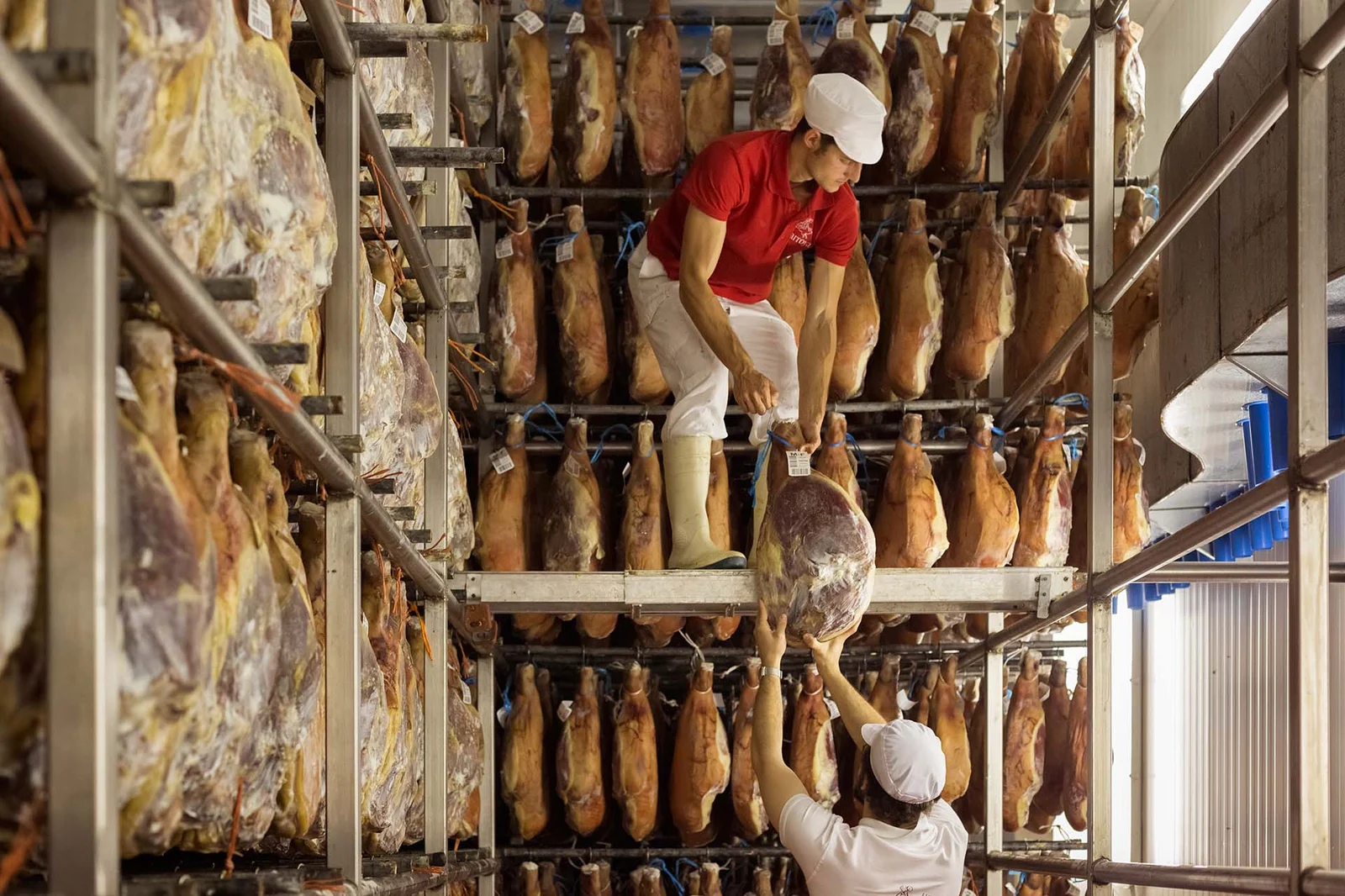
After washing, the hams move into the post-salting rooms, where they remain for at least 60 days, always under strictly controlled temperature and humidity conditions.
“Every pig has its Saint Martin's Day”
As the Spanish saying goes, “Every pig has its Saint Martin's Day”. The 11th of November heralded the cold winter and, with it, the traditional pig slaughter, providing hams and shoulders among other delicacies.
Our grandparents knew what they were doing: they used the coldest months to prepare meat and preserve it with oil, salt, spices or smoke, depending on the region.
In Aragón, salt and the cold, dry winter were enough to cure and preserve ham. That is exactly what we reproduce in our post-salting rooms: that cold winter our parents and grandparents so often describe.
Being able to control a season has its advantages, as we will see below!
What happens during post-salting?
At this stage, the salt added during salting spreads throughout the ham, making it a stable food protected against bacterial growth.
Put simply:
- As the surface of the ham dries,
- The salt moves inwards, where the water concentration is higher,
- Creating an even distribution of salt and allowing drying and maturation to progress naturally.
The temperature in these rooms rises slowly:
- It starts at around 2 °C,
- And finishes at around 6 °C,
- Over a minimum of 60 days.
When the salt has fully spread and the ham has lost approximately 20% of its weight, the product is considered stable and ready for the next stage: spring, or, in other words, drying.
Our advice
At Jamones Villarroya, we make this ‘winter season’, or post-salting stage, last 100 to 120 days. This lets us produce ham with very little salt that is nevertheless stable against bacteria.
If we allowed only 60 days, our ham could spoil. We are in no hurry: as we saw in the previous article, gentle salting combined with slow curing produces higher-quality ham.
Comments (0)